
Linear Control System
Instructions:
- The marks are indicated in the right-hand margin.
- There are NINE questions in this paper.
- Attempt FIVE questions in all.
- Question No. 1 is compulsory.
At high frequency, the asymptotic slope of the Bode magnitude plot for the transfer function G(s) = 100/[s(1+0.2s)(1+0.02s)]
The characteristic equation of a system is s3 + 5s2 + 8s + K = 0 for marginal stability, the value of K is
For the transfer function G(s) = 1/(s+1) the magnitude at ω = 1 rad/s is
For a system with an open-loop transfer function G(s)H(s) = K/[s(s+2)(s+4)] the number of asymptotes in the root locus is
The root locus technique graphically shows the movement of
A system is completely controllable if
For a unity feedback system with an open-loop transfer function G(s) = 20/[s(s+4)] the velocity error constant, Kv
For a minimum phase system, all zeros lie in
Which of the following devices converts shaft angular position into an electrical signal used for error detection in servo systems?
The steady-state error for a Type-1 system subjected to unit step input is
The open-loop transfer function of a control system is given below: G(s)H(s) = 30/[s(1+0.5s)(1+0.08s)]. Draw the Bode plot and determine: P.M., G.M., and comment on the closed-loop stability of the system.
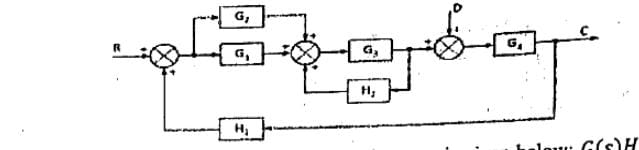
Find C/R, C/D, and the total output for the system whose block diagram is shown below
The open-loop transfer function of a control system is given below: G(s)H(s) = K/[s(s+6)(s2+4s+13)]. Sketch the root locus and find the range of K for the system to be stable.
Determine the sensitivity of the overall transfer function at ω = 1 rad/sec w.r.t.
(i) Forward path transfer function (ii) Feedback path transfer function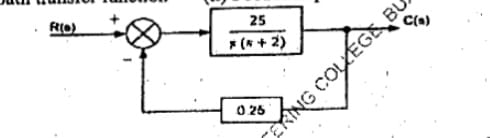
Obtain the time response of the system given below: ẋ = Ax, where A = [0 1; −2 0]; x(0) = [1; 1] and y = [1 −1] [x1; x2].
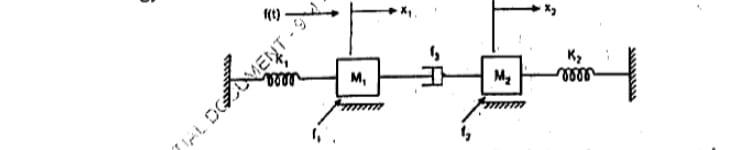
For the given translational mechanical system, find the Force–Voltage (F-V) analogy.
Check the controllability of the system defined by the state matrix A = [0 1 0; 0 0 1; −6 −11 −6], B = [1; 0; 1], C = [10 5 1].
The open-loop transfer function of a control system is given below: G(s) = K/[s(1+0.2s)]. Design a suitable compensator such that the system will have Kv = 10 and P.M. = 50°.
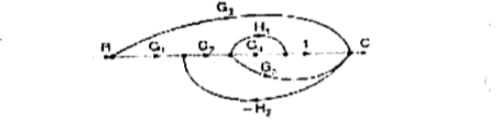
Find the transfer function C/R
Using Nyquist stability criteria, examine the closed-loop stability of a control system whose open-loop transfer function is given below: G(s)H(s) = K/[s(1+sT)].
The open-loop transfer function of a control system is given by G(s) = K/[s(1+sT1)(1+sT2)]. Apply Routh-Hurwitz criteria to determine the values of K in terms of T1 & T2 for the system to be stable.
A second-order system is represented by a transfer function given below θo(s)/T(s) = 1/(Js2+fs+k), where θo the proportional output and T is the input torque. A step input of 10 Nm is applied to the system, and the test results are given below: Mp = 6 %, tp = 1sec, and steady state output is 0.5 rad. Determine the values of J, f & k.
Absolute, conditional, and marginal stability with suitable examples
Nyquist stability criterion
P, PI, and PID controllers.
Concepts of controllability and observability