
CONTROL SYSTEMS DESIGN
Instructions:
- The marks are indicated in the right-hand margin.
- There are NINE questions in this paper.
- Attempt FIVE questions in all.
- Question No. 1 is compulsory.
Discuss the requirement of compensation of a control system.
Define resonant peak and resonant frequency.
Define underdamped, overdamped and critically damped systems.
Write design steps of lag compensator.
Define phase-plane technique.
What do you mean by describing function?
Define State regulator problem via Riccati equation.
Write the advantages and disadvantages of static error coefficient method.
Write the effect of lag-lead compensator.
Define controllability and observability.
A unity feedback servo driven instrument has open-loop transfer function
G(s) = 10/(s(s + 2))
find the following :
(i) The time domain response for a unit step input;
(ii) The natural frequency of oscillation;
(iii) The maximum overshoot and peak time;
(iv) Steady-state error to an input 1 + 4t.A unity feedback servo driven instrument has open-loop transfer function
G(s) = K/(s(sT + 2))
(i) Find the factor by which the gain (K) must be multiplied so that the damping ratio increases from 0.3 to 0.9.
(ii) Find the factor by which the time constant (T) must be multiplied so that the damping ratio decreases from 0.9 to 0.3.
(iii) Show that
(TK1 − 1)/(TK1 − 2) = 11.39
when the system overshoot reduces from 70% to 30% where K1 and K2 are values of K for 70% and 30% overshoot.
Derive peak overshoot. Find J and D for the system shown in figure below to yield 35% peak overshoot and a settling time of 1.5 seconds (for 2% error band) for a step input of torque T(t) :

The block diagram of closed-loop control system is shown in figure below. Determine the steady-state error to the unit ramp input, damping ratio and settling time for the system without derivative feedback. Also discuss the effect of derivative feedback on transient and steady-state behaviour of the system assuming α = 0.2 :
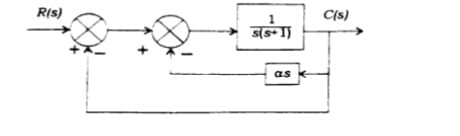
For a given unity feedback control system with forward path transfer function
G(s) = 120/(s(s + 12.63))
Determine the following :
(i) The damping ratio when a unit step input is applied;
(ii) The damping ratio, percentage peak overshoot and settling time if a PD controller with Kp = 1 and KD = 1/40 is introduced in the forward path.A 2nd-order system has overshoot of 40% and period of oscillations 0.25 sec. when subjected to unit step input. Determine the resonant peak, resonant frequency and bandwidth.
Develop and discuss the necessary and sufficient condition for pole-placement.
Develop the Ackermann's formula for determination of state feedback gain matrix.
A regulator system has a plant
Y(s)/U(s) = 24/((s + 1.5)(s + 4.5)(s + 3.5))
Define state variable as x1 = 2y and x2 = 3ẋ1, x3 = 5ẋ2. By use of the state feedback control u = −Kx, it is desired to place the closed-loop poles at s = −4 ± √3j and s = −12. Determine the necessary state-feedback gain matrix K.Derive the expressions peak time and peak overshoot for 2nd-order system.
The open-loop transfer function with unity feedback is given by
G(s) = 20/(s(s + 8))
Design a lead compensator such that the closed-loop system satisfies the following specifications :
Static velocity error constant = 15 s−1
Phase margin = 55°
Gain margin ≥ 12 dBA system has
G(s) = 0.035/(s(1 + 0.5s)(1 + 0.04s))
Design a suitable lag compensator to give velocity error constant 27.3 s−1 and phase margin = 45°.
Explain singular point. Find out the singular point for the following systems :
(i) y″ + 5y′ − 20 = 0
(ii) y″ + 3.5y′ + 2.5y = 0
Show the trajectories of the singular point.Consider the system defined by
=ẋ1 ẋ2 ẋ3 0 1 0 0 0 1 1.78 0.55 −5.5
+x1 x2 x3
u0 0 1.54
y = [1 0 0]x1 x2 x3
Given the set of desired poles for the observer to be s = −4.2 ± 1.3√3j and s = −11. Design a full-order observer.
Describe the different types of singular points and discuss their importance in stability analyses of non-linear system.
Derive the describing function of saturation non-linearity.